


How to Buy Germany Made Bearings from Trusted Suppliers?
Buying Germany Made Bearings is not simply a matter of choosing a familiar country label. It requires checking the supplier, manufacturing origin, technical data, and after-sales support. A bearing may look flawless in a catalog, yet fail early when its load rating, clearance, or sealing design does not match the machine. That detail matters.
Dr. Stefan Spindler, a respected Schaeffler industrial executive, has emphasized: “Quality must be proven in the application, not promised in a brochure.” This principle gives buyers a practical starting point. Trusted suppliers should provide traceable product numbers, factory documentation, inspection records, and clear warranty terms. Ask where the bearing was produced. Ask how it was tested. Request samples when the application is critical.
Experience also teaches caution. Low prices can hide old inventory, unclear sourcing, or unsuitable substitutes. A professional supplier will discuss speed, temperature, vibration, lubrication, and expected service life before recommending a product. They will not avoid difficult questions.
Small details reveal credibility.
This guide will explain how to compare authorized distributors, verify Germany Made Bearings, review certificates, and assess technical support. It will also examine common purchasing mistakes, including relying on packaging alone. No supplier is perfect, and even experienced buyers can overlook one important specification. Careful verification remains necessary. Reliable purchasing is built through evidence, communication, and repeatable checks—not attractive claims.
Understanding German-Made Bearing Standards and Product Types
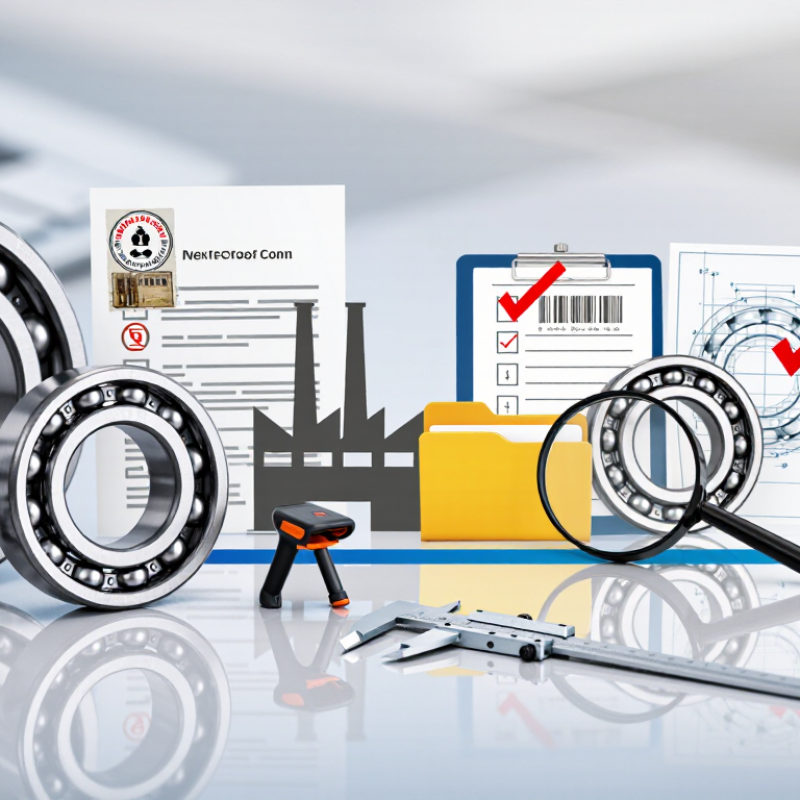
Buying Germany-made bearings starts with understanding what “German-made” actually means. It should indicate documented manufacturing origin, not simply German design or packaging. Ask suppliers for traceability records, inspection reports, and certificates matching the production batch. ISO 492 helps define dimensional accuracy and running tolerances. ISO 9001 supports quality-management control, but it does not prove every bearing is perfect.
Bearing type must match the machine. Deep-groove ball bearings suit general radial loads and moderate speeds. Angular-contact bearings manage combined loads and often support precision spindles. Cylindrical roller bearings carry heavy radial loads. Tapered roller bearings handle radial and axial forces together. Spherical roller bearings tolerate shaft misalignment, which can save a poorly aligned assembly. Sealing also matters. A 2RS seal protects against dust, while an open bearing may need regular lubrication.
Tips: Confirm the required bore, outside diameter, width, clearance, load rating, and operating temperature. Check whether C3 clearance is necessary for heat or interference fits. Trusted suppliers should explain these choices clearly, not just quote the lowest price. Inspect packaging, markings, and lubricant condition when the shipment arrives. I have seen buyers focus on price and overlook storage history. That mistake can shorten bearing life before installation. Certificates deserve checking too; a neat document is not always reliable evidence.
| Data Dimension | Bearing Type or Specification | Relevant Standard or Technical Reference | What to Verify | Typical Application | Purchasing Guidance |
|---|---|---|---|---|---|
| Product Type | Deep-groove ball bearing | ISO 15; ISO 492; ISO 281 | Radial load rating, limiting speed, internal clearance, sealing arrangement, and dimensional accuracy | Electric motors, pumps, gearboxes, fans, and general machinery | Provide the exact bore, outside diameter, width, clearance class, seal or shield configuration, and required load rating before requesting a quotation. |
| Product Type | Angular-contact ball bearing | ISO 15; ISO 492; ISO 281 | Contact angle, single- or double-row design, preload, precision class, and paired-bearing arrangement | Machine-tool spindles, pumps, compressors, and precision drives | For paired bearings, confirm the arrangement, preload level, mounting orientation, and whether matched pairing is required. |
| Product Type | Spherical roller bearing | ISO 15; ISO 492; ISO 281 | High radial load capacity, permissible misalignment, axial load capability, cage design, and lubrication method | Conveyors, crushers, fans, paper machinery, and heavy industrial equipment | Check shaft and housing fits, operating temperature, vibration level, and whether relubrication provisions are available. |
| Product Type | Tapered roller bearing | ISO 355; ISO 281 | Cup-and-cone dimensions, equivalent dynamic load, axial load direction, preload, and adjustment requirements | Wheel hubs, gearboxes, axles, and heavily loaded rotating assemblies | Purchase the matching cup and cone set when required, and verify the mounting preload or end-play specification. |
| Product Type | Cylindrical roller bearing | ISO 15; ISO 492; ISO 281 | Flange configuration, axial displacement capability, radial load rating, clearance, and cage material | Electric motors, generators, industrial gearboxes, and high-radial-load systems | Confirm whether the bearing must accommodate axial displacement and identify the fixed or locating-bearing position. |
| Product Type | Thrust ball bearing | ISO 104; ISO 281 | Single- or double-direction axial capacity, speed limit, washer configuration, and minimum axial load | Vertical shafts, turntables, screw mechanisms, and low-to-moderate-speed axial applications | Do not substitute a thrust bearing for a radial bearing without checking the axial-load direction and shaft support arrangement. |
| Dimensional Accuracy | Normal, P6, P5, P4, or P2 tolerance class | ISO 492 | Bore and outside-diameter tolerances, width variation, radial runout, and axial runout | From standard industrial equipment to precision machine-tool spindles | Select the precision class according to speed, runout, temperature stability, and system accuracy; a tighter class is not automatically better for every application. |
| Internal Clearance | C2, CN, C3, C4, or C5 radial clearance | ISO 5753-1 | Radial internal clearance before mounting, operating temperature, interference fit, and thermal expansion | Standard machinery, hot-running equipment, electric motors, and high-temperature assemblies | The correct clearance depends on fits and operating temperature; do not assume that C3 is universally suitable. |
| Load Rating | Basic dynamic load rating and basic static load rating | ISO 281 | Equivalent dynamic load, equivalent static load, rotational speed, contamination, lubrication, and required fatigue life | All rolling-bearing applications with rotating or oscillating loads | Compare the calculated bearing life with the required service life and include shock loads, misalignment, and contamination in the assessment. |
| Vibration and Noise | Measured vibration performance | ISO 15242 | Measurement method, vibration limits, test conditions, rotational speed, and acceptance criteria | Motors, pumps, fans, precision drives, and low-noise equipment | Request a defined vibration grade or test report instead of relying only on general statements such as “low noise.” |
| Material | Through-hardened bearing steel, commonly designated 100Cr6 | DIN EN ISO 683-17 | Steel designation, heat-treatment condition, hardness, material traceability, and manufacturing batch | General-purpose rolling elements and bearing rings | Ask for a material certificate or batch traceability record when the bearing is used in safety-critical or heavily loaded equipment. |
| Sealing and Lubrication | Open, shielded, or sealed configuration | Manufacturer technical specification; ISO 16269-6 may support statistical quality evaluation where applicable | Seal material, grease type, filling quantity, temperature range, relubrication access, and chemical compatibility | Clean environments, dusty areas, wet machinery, and maintenance-restricted equipment | Confirm whether the bearing is pre-greased and whether the lubricant is compatible with the equipment temperature, speed, and surrounding chemicals. |
| Origin Verification | German manufacturing origin | EU non-preferential origin rules; supplier declaration and commercial documentation | Country-of-origin statement, production site, batch or lot number, invoice details, and consistency between packaging and documents | Procurement requiring documented German origin or controlled supply chains | Treat “German-made” as an origin claim that must be documented; German design, German distribution, or German-language packaging alone does not prove manufacture in Germany. |
| Supplier Qualification | Authorized or technically accountable industrial supplier | ISO 9001 quality-management certification may support supplier evaluation | Traceability system, inspection process, storage conditions, warranty terms, technical support, and counterfeit-control procedures | Routine replacement parts and critical production machinery | Request a datasheet, inspection certificate, certificate of conformity, and clear return policy before placing a volume order. |
| Storage and Handling | Clean, dry, vibration-free bearing storage | Supplier storage instructions and applicable preservation requirements | Packaging integrity, corrosion protection, storage date, humidity exposure, contamination, and evidence of repacking | Long-term inventory, maintenance stores, and emergency spare-parts stock | Reject packages with damaged seals, corrosion, missing lot information, or unexplained relabeling; rotate stock using a first-in, first-out approach. |
Related Posts
-
Top 10 Pillow Block Bearing Types You Should Know?
-
Why Do Roller Bearing Prices Vary Worldwide?
-
Top Roller Bearing Suppliers in China for Global Buyers?
-
Why Miniature Ball Bearings Are Essential in Modern Machinery?
-
Top 2025 Guide to Flange Bearings Applications and Benefits Explained
-

Top Roller Bearing Factories in China for Global Buyers?
-

Phone
-

E-mail
-

Whatsapp
-

Wechat
Wechat
