


Top 10 Types of Miniature Bearings for Buyers
Miniature bearings are easy to overlook, yet they can determine whether a compact motor runs smoothly or vibrates under load. Their small dimensions leave little room for errors in fit, lubrication, or alignment. For buyers, “miniature” does not describe one universal design. It covers several bearing types, each suited to different loads, speeds, and operating conditions.
Industry research helps explain why careful selection matters. Grand View Research’s Bearing Market Size, Share & Trends Analysis Report tracks demand across sectors including automotive, aerospace, and industrial machinery. These broad markets increasingly rely on compact, precise components, but the report does not rank miniature bearing types individually. That distinction matters. Buyers should combine market context with technical evidence, rather than treat general growth forecasts as proof that one bearing fits every application. Check load direction, shaft speed, available space, temperature, and expected service life. A bearing that feels smooth on a sample shaft may still fail when exposed to dust or poor lubrication.
This guide compares ten common types, from miniature deep-groove ball bearings to thrust and needle designs. SKF’s rolling-bearing technical guidance offers practical reference points for load ratings, fits, and lubrication; manufacturers’ specifications should still be checked for each part number. Small differences matter. A thin washer, a slight misalignment, or a dry start can change performance. The categories below are a starting point, not a substitute for testing. That caveat is easy to miss. Buyers who compare verified dimensions and operating limits can make a more defensible choice—and avoid paying for precision they do not need.
Miniature Bearing Basics: Structure, Materials, and Operating Principles
Miniature Bearing Basics: Structure, Materials, and Operating Principles
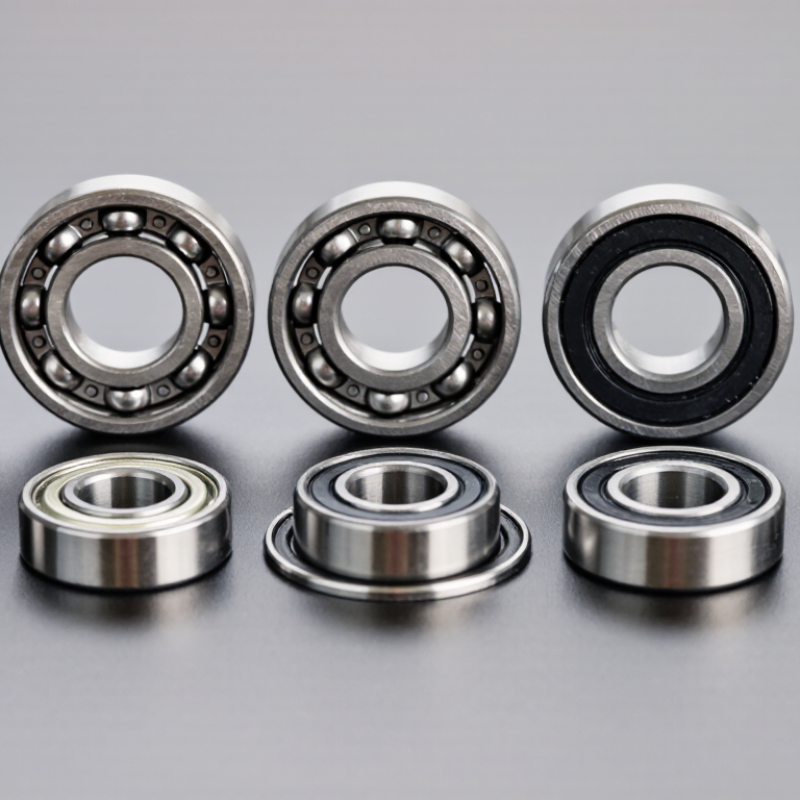
Miniature bearings support small shafts in medical instruments, optical devices, encoders, and compact motors. Their structure is simple: an inner ring, outer ring, rolling elements, cage, and seals. Typical rolling elements use stainless steel or ceramic materials. Stainless steel offers toughness and cost control. Ceramic elements reduce weight and electrical conductivity. The choice is rarely perfect.
A miniature bearing works by replacing sliding friction with rolling contact. The raceways guide the balls while the cage maintains spacing. Grease or oil forms a thin film between surfaces. Poor lubrication can cause heat, noise, and early fatigue. ISO 281 calculates bearing rating life through load, speed, and reliability factors. Actual service life may differ because contamination and misalignment remain difficult to measure.
The U.S. Department of Energy’s Motor Systems Market Assessment reports that motor-driven equipment consumes about 68% of industrial electricity in the United States. Even tiny bearings can influence efficiency in high-speed assemblies. A 2024 Research and Markets outlook values the global bearing sector above USD 100 billion, although estimates vary by scope and region. Buyers should check bore size, radial load, speed, clearance, seal type, and operating temperature. A sealed bearing may protect against dust, but it can also increase drag. Sometimes, the “best” specification is only the least unsuitable one.
| No. | Miniature Bearing Type | Basic Structure | Operating Principle | Common Materials | Typical Load Capability | Typical Speed Capability | Best-Suited Applications | Key Buying Considerations |
|---|---|---|---|---|---|---|---|---|
| 1 | Deep-Groove Ball Bearing | Inner ring, outer ring, deep raceway grooves, balls, cage, and optional seals or shields. | Rolling balls transmit radial loads and moderate axial loads while reducing sliding friction between the rings. | Hardened bearing steel is common; stainless steel is used where corrosion resistance is required. Cages may be steel, brass, or polymer. | Moderate radial and light-to-moderate axial loads. | High; generally one of the fastest miniature bearing designs. | Small motors, fans, instruments, office equipment, pumps, and compact gear assemblies. | Choose the correct bore, outside diameter, width, radial clearance, seal type, lubrication, and precision grade. |
| 2 | Flanged Ball Bearing | A miniature deep-groove bearing with an integral flange on the outer ring or, less commonly, the inner ring. | Rolling elements carry the load while the flange provides axial positioning in a housing or mounting plate. | Chrome bearing steel, stainless steel, polymer cages, and rubber or metal shields. | Moderate radial loads and limited axial loads; flange primarily supports positioning rather than heavy thrust. | High, depending on lubrication, internal clearance, and seal design. | Printed equipment, small fans, guide rollers, compact mechanisms, and applications with thin housing walls. | Verify flange diameter, flange location, shoulder dimensions, housing fit, and axial retention requirements. |
| 3 | Shielded Miniature Ball Bearing | Deep-groove ball bearing fitted with non-contact metal shields on one or both sides. | Balls roll along the raceways; shields reduce lubricant loss and limit entry of larger dust particles without contacting the inner ring. | Chrome bearing steel or stainless steel rings and balls; steel shields; grease or oil lubrication. | Moderate radial loads and light-to-moderate axial loads. | Very high because non-contact shields produce little additional friction. | Clean or moderately clean high-speed equipment, electric motors, fans, and precision instruments. | Use when low friction and speed are more important than strong protection against moisture or fine contaminants. |
| 4 | Sealed Miniature Ball Bearing | Deep-groove ball bearing with contact or low-contact elastomer seals on one or both sides. | Rolling balls support rotation while seals retain grease and provide a barrier against dust, moisture, and contamination. | Chrome steel or stainless steel bearing components; nitrile rubber, fluorocarbon rubber, or other elastomer seals. | Moderate radial loads and light-to-moderate axial loads. | High, though usually lower than an equivalent shielded bearing because seal friction generates additional heat. | Small appliances, actuators, outdoor instruments, medical devices, and equipment exposed to light contamination. | Compare seal material, temperature range, water resistance, starting torque, grease type, and service life. |
| 5 | Angular-Contact Ball Bearing | Raceways are offset relative to each other, creating a defined contact angle between the balls and raceways. | The contact angle allows the bearing to carry combined radial and axial loads, especially when mounted in pairs. | Hardened bearing steel or stainless steel; steel, brass, or polymer cage options. | Moderate radial loads and higher axial-load capability than standard deep-groove bearings. | High, but preload and contact angle affect heat generation and maximum speed. | Precision spindles, compact actuators, lead-screw supports, robotics, and high-accuracy rotating assemblies. | Specify contact angle, arrangement, preload, pair matching, axial direction, and required running accuracy. |
| 6 | Thrust Ball Bearing | Two raceway washers, a ball set, and a cage arranged primarily for axial loading. | Balls roll between the washers to support axial force; the design is generally unsuitable for significant radial loads. | Chrome bearing steel, stainless steel, polymer or steel cages, and application-specific lubricants. | Light-to-moderate axial loads with limited radial-load capability. | Moderate; usually lower than comparable radial bearings because of axial contact geometry. | Vertical shafts, small screw mechanisms, rotary controls, indexing devices, and low-load axial positioning systems. | Confirm load direction, washer alignment, shaft speed, allowable misalignment, and whether radial support is provided separately. |
| 7 | Self-Aligning Ball Bearing | Two rows of balls run on an outer-ring spherical raceway, allowing the inner ring to tilt relative to the outer ring. | The spherical outer raceway compensates for small shaft or housing misalignment while balls carry radial and limited axial loads. | Chrome bearing steel or stainless steel; steel, brass, or polymer cages. | Moderate radial loads and limited axial loads. | Moderate to high, depending on misalignment, lubrication, and internal clearance. | Light machinery, guide systems, compact conveyors, and assemblies where housing alignment is difficult to maintain. | Check allowable angular misalignment, radial clearance, axial load, mounting method, and available radial space. |
| 8 | Ceramic Hybrid Ball Bearing | Steel rings are paired with ceramic balls, usually made from silicon nitride, plus a suitable cage and lubricant. | Hard, lightweight ceramic balls reduce mass, electrical conductivity, and frictional effects while rolling between steel raceways. | Hardened steel rings, silicon nitride balls, and polymer or phenolic cages. | Moderate radial loads; axial capacity depends on the bearing design and preload. | Very high, with low centrifugal forces and reduced heat generation at elevated rotational speeds. | High-speed motors, precision spindles, vacuum-related equipment, laboratory instruments, and electrically sensitive systems. | Evaluate cost, electrical insulation needs, preload, lubrication compatibility, temperature, and shock-loading conditions. |
| 9 | Full-Complement Ball Bearing | A ball bearing containing the maximum practical number of balls, generally without a cage. | The increased number of balls raises static and low-speed load capacity, but adjacent balls slide against one another during rotation. | Hardened bearing steel or stainless steel; lubricant selected for relatively low-speed operation. | High radial load capacity for its size, particularly at low speed or under oscillating motion. | Low to moderate because ball-to-ball contact increases friction, heat, and wear. | Slow-moving slides, compact mechanisms, oscillating joints, and space-limited high-load applications. | Prioritize load capacity over speed; check lubrication, duty cycle, oscillation angle, temperature, and contamination control. |
| 10 | Thin-Section Ball Bearing | A radial ball bearing with a relatively small cross-section compared with its bore diameter, often using a lightweight raceway design. | Rolling balls provide radial and limited axial support while the thin cross-section saves space and reduces rotating mass. | Chrome bearing steel, stainless steel, ceramic balls, polymer cages, and contact or non-contact seals. | Light-to-moderate loads; capacity is limited by the small cross-section and raceway size. | Moderate to high, depending on diameter, internal clearance, seal type, and lubrication. | Robotic joints, optical equipment, encoders, compact gearboxes, aerospace instruments, and space-constrained mechanisms. | Check static load safety, shaft and housing stiffness, deflection, runout, cross-sectional size, and required precision. |
Related Posts
-

Exploring the Science Behind Miniature Bearings and Their Role in Modern Technology
-
2025 Guide: How to Choose the Best Miniature Ball Bearings for Your Project
-
Top Miniature Bearings for Global Buyers How to Choose?
-
Why Choose Miniature Ball Bearings for Your Projects?
-
What Are the Top Small Bearing Types for Global Buyers?
-
What Are the Top Miniature Ball Bearings in 2026?
-

Phone
-

E-mail
-

Whatsapp
-

Wechat
Wechat
