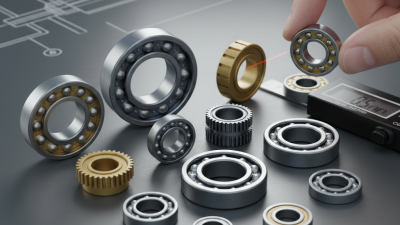
2026 Best Hardware Bearing Manufacturers for Global Buyers

Choosing a reliable Hardware Bearing manufacturer in 2026 requires more than comparing catalog prices. Global buyers need verified production capability, stable quality, and responsive technical support. A bearing may look simple, yet its steel grade, heat treatment, clearance, and sealing design affect every rotation.

This guide examines manufacturers through practical purchasing criteria. These include factory experience, engineering resources, quality systems, testing equipment, and export performance. It also considers ISO certifications, material traceability, dimensional inspection, and batch consistency. Real evaluation often starts with a drawing, a sample order, and a detailed conversation with an applications engineer. Small details matter. A clean inspection report helps.

Leading suppliers should explain load ratings, operating temperatures, lubrication options, and expected service life. They should also provide clear tolerances and suitable packaging for long-distance transport. On-site audits can reveal useful facts, such as organized storage, calibrated gauges, and visible process controls. However, certificates alone cannot prove dependable performance. Independent testing and customer references add stronger evidence.

Market conditions may change during 2026. Prices, lead times, and material availability can shift unexpectedly. No manufacturer remains perfect across every bearing type or region. That limitation deserves attention. Buyers should match each supplier with the actual application, not with a polished website. This overview offers a practical starting point for comparing global Hardware Bearing manufacturers with greater confidence, fewer surprises, and better long-term value.
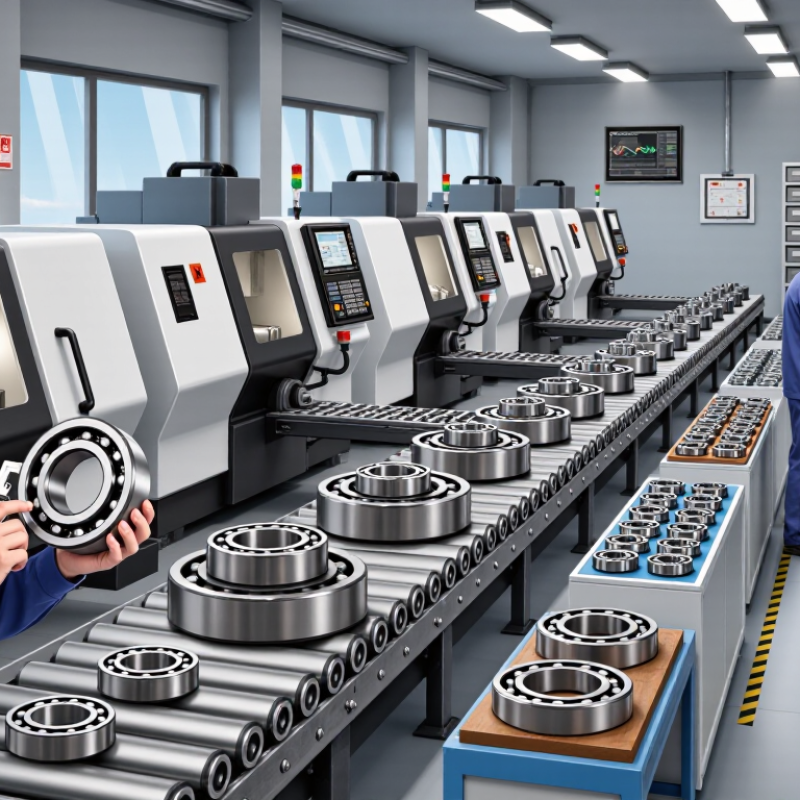
2026 Best Hardware Bearing Manufacturers for Global Buyers

Bearing Types and Uses: Ball, Roller, Thrust, and Plain Designs

2026 Best Hardware Bearing Manufacturers for Global Buyers

Bearing selection begins with the load, speed, motion, and environment—not the catalogue price.

Ball bearings suit moderate radial loads and high rotational speeds, such as electric motors, pumps, and conveyors. Their low friction is useful, but contamination can shorten service life quickly.

Roller bearings provide greater load capacity through line contact. Cylindrical, tapered, and spherical designs handle different radial, combined, or misalignment conditions.

Thrust bearings manage axial loads. They fit screw mechanisms, turntables, and vertical shafts, but many designs tolerate limited radial force.

Plain bearings use sliding contact instead of rolling elements. They are practical in hinges, low-speed pivots, and oscillating joints, especially where shock loads or dirt make rolling elements vulnerable. Maintenance experience matters here. A dry-looking joint may already be wearing internally.

Industry forecasts show why this knowledge matters. Fortune Business Insights valued the global bearing market at about 128 billion US dollars in 2024 and projected continued growth through 2032. The U.S. Department of Energy also reports that motor-driven systems consume a major share of industrial electricity, making friction and alignment economically important.

These figures support careful specification, not automatic premium purchasing. I would still question any report that treats every application equally. Temperature, lubrication intervals, shaft hardness, sealing, and installation accuracy can matter more than bearing type alone.

Buyers should request test data, traceable materials, tolerance records, and documented load-life calculations from manufacturers. Samples should be inspected under the actual operating conditions, not only in a clean laboratory.

Technical Benchmark: ISO 281 L10 Life, Dynamic Loads, and ISO 492 Tolerances

2026 Best Hardware Bearing Manufacturers for Global Buyers

Technical Benchmark: ISO 281 L10 Life, Dynamic Loads, and ISO 492 Tolerances

A credible bearing manufacturer should explain performance with ISO 281 calculations, not vague service-life claims. L10 life predicts the number of revolutions that 90% of identical bearings can reach under stated conditions. The calculation uses L10 = (C/P)p where C is the basic dynamic load rating and P is the equivalent dynamic bearing load. The exponent is usually 3 for ball bearings and 10/3 for roller bearings. Small errors matter.

Load data needs practical context. A bearing rated at 50 kN does not automatically support a 50 kN application load. Speed, lubrication, contamination, misalignment, temperature, and shock can reduce real service life. For example, a conveyor bearing near a dusty transfer point may fail early despite a favorable L10 result. Engineers should request load spectra, speed ranges, grease specifications, and calculation assumptions. A clean spreadsheet is not proof.

ISO 492 tolerances provide a common language for dimensional accuracy. Buyers should check bore, outside diameter, width, and radial variation against the specified tolerance class. Tight tolerances can improve fit and running behavior, but they do not guarantee low noise or perfect assembly. Inspectors should compare inspection reports with traceable gauges and production batches. In my view, this is where supplier reviews often become too optimistic. Ask for recent data. Question unexplained averages. Reliability begins with evidence that survives a second inspection.

2026 Manufacturer Profiles: Capacity, Certifications, and Product Range

2026 buyers should compare bearing manufacturers by verified capacity, certifications, and product range. Market demand is becoming more technical. Grand View Research reports continued growth in the global bearing market, driven by automotive, wind power, robotics, and industrial machinery. Capacity figures therefore matter, but only when supported by factory evidence.

A credible manufacturer profile should state annual output, production lines, heat-treatment capability, and monthly export volume. It should also identify bearing types, sizes, cage materials, seals, lubrication options, and customization limits. ISO 9001 certification supports quality management, while IATF 16949 is relevant for automotive supply chains. ISO 14001 and ISO 45001 show environmental and occupational controls. However, certificates alone are not enough. Audit dates, issuing bodies, and scope descriptions deserve careful checking.

Product accuracy remains critical. ISO 492 defines tolerance classes for rolling bearings, while ISO 199 covers thrust-bearing dimensional and geometric tolerances. The U.S. Department of Energy reports that motor-driven systems can consume more than half of industrial electricity, making friction, heat, and service life practical purchasing concerns. Manufacturers should provide test records, batch traceability, failure analysis, and inspection data. Capacity figures can age quickly. I would also question unusually high claims without workforce, equipment, or delivery evidence. That small doubt often prevents a costly decision.

2026 Best Hardware Bearing Manufacturers for Global Buyers

Manufacturer profile benchmark based on commonly documented global bearing capabilities, including production scale, certification coverage, and product-family breadth. Values are presented without company or brand names.

The capacity score combines reported manufacturing scale, automation level, and export readiness. Certification coverage reflects the most frequently documented quality, environmental, automotive, and occupational-safety standards in international bearing manufacturing.

Global Buyer Scorecard: Price, MOQ, Lead Time, Warranty, and Service Data

2026 Best Hardware Bearing Manufacturers for Global Buyers

A practical scorecard should compare price, MOQ, lead time, warranty, and service in one table. Price alone misleads. A low unit quote may hide tooling, inspection, packaging, or urgent freight costs. Record landed cost per 1,000 pieces, currency, payment terms, and replacement policy. The World Bank’s 2023 Logistics Performance Index evaluates customs, infrastructure, tracking, and timeliness. These factors directly affect delivery risk. UNCTAD’s Review of Maritime Transport 2023 reports that over 80% of global trade by volume moves by sea, so port exposure matters.

MOQ deserves a production-based test. Ask whether suppliers can offer trial quantities without changing material or inspection standards. Lead time should show production days, dispatch days, and a documented escalation route. For warranty checks, request coverage length, evidence requirements, and response time. ISO 281-1 remains a useful reference for bearing rating life, but laboratory ratings do not guarantee field performance. Installation, contamination, load variation, and lubrication still matter. I would not treat an impressive certificate as complete proof. That is an easy mistake.

Tips: Score each category from one to five. Keep photos of labels, packing, and test reports. Require a sample approval before volume production. Review three shipments, not one. Service quality often appears after the first defect, when promises become measurable actions.

2026 Best Hardware Bearing Manufacturers for Global Buyers – Global Buyer Scorecard: Price, MOQ, Lead Time, Warranty, and Service Data

Anonymous 2026 market benchmark by bearing category and supplier capability. Figures represent commonly quoted commercial ranges for standard industrial products and are intended for preliminary global sourcing comparisons.

Bearing Category Typical Industrial Application Indicative Unit Price
(USD, FOB)
Typical MOQ Standard Lead Time Custom or OEM Lead Time Typical Warranty Technical Response Time Quality Documentation Buyer Service Score
(100-point scale)
Commercial Risk Level
Deep-Groove Ball Bearings Electric motors, pumps, conveyors, fans, gearboxes, and general machinery US$0.35–12.00 per piece 100–500 pieces 2–6 weeks 6–10 weeks 12–24 months Within 1 business day Certificate of conformity, dimensional report, material or heat-treatment records where applicable 86 Low–Medium
Angular Contact Ball Bearings Machine tools, precision spindles, pumps, compressors, and high-speed assemblies US$3.00–85.00 per piece 50–200 pieces 4–8 weeks 8–14 weeks 12–24 months Within 1 business day Runout, preload, accuracy-class, dimensional, and traceability documentation 82 Medium
Tapered Roller Bearings Automotive hubs, transmissions, industrial gearboxes, axles, and heavy-duty drives US$2.50–75.00 per piece 50–300 pieces 4–8 weeks 8–12 weeks 12–24 months Within 1–2 business days Load-rating data, dimensional inspection, heat-treatment records, and batch traceability 84 Medium
Spherical Roller Bearings Mining equipment, paper machines, crushers, conveyors, and heavy industrial machinery US$18.00–450.00 per piece 10–50 pieces 6–12 weeks 10–16 weeks 12–18 months Within 1–3 business days Load-rating calculations, dimensional report, material certificate, and inspection records 78 Medium–High
Cylindrical Roller Bearings Electric motors, generators, gearboxes, compressors, and high-load rotating equipment US$4.00–160.00 per piece 25–150 pieces 5–10 weeks 9–14 weeks 12–24 months Within 1–2 business days Dimensional inspection, radial-clearance report, material certificate, and batch records 81 Medium
Thrust Ball Bearings Low-to-moderate speed axial-load applications, turntables, jacks, and positioning systems US$1.20–35.00 per piece 50–300 pieces 3–7 weeks 7–12 weeks 12–24 months Within 1 business day Certificate of conformity, dimensional report, and load or clearance data where specified 83 Low–Medium
Needle Roller Bearings Automotive systems, compact transmissions, printing equipment, and space-constrained assemblies US$0.80–28.00 per piece 100–500 pieces 4–9 weeks 8–14 weeks 12–18 months Within 1–2 business days Dimensional report, hardness data, material certificate, and batch traceability 79 Medium
Mounted Bearing Units Material handling, agricultural machinery, food-processing lines, and conveyor systems US$3.00–55.00 per unit 50–200 units 3–8 weeks 7–12 weeks 12–24 months Within 1 business day Housing and insert inspection, conformity certificate, sealing specification, and batch records 85 Low–Medium
Thin-Section Bearings Robotics, automation, medical equipment, aerospace mechanisms, and precision instruments US$25.00–650.00 per piece 10–50 pieces 8–16 weeks 12–24 weeks 12–18 months Within 2–3 business days Accuracy-class report, runout data, dimensional inspection, material certificate, and traceability 75 High
Benchmark notes: Prices are indicative USD ranges for standard industrial sizes, ordinary carbon or chrome-bearing steel, normal commercial quantities, and FOB shipment terms; taxes, freight, tooling, and special packaging are excluded. MOQ and lead time vary by size, precision class, sealing configuration, material, certification requirements, production location, and order season. Warranty periods commonly depend on correct installation, lubrication, operating load, speed, contamination control, and documented maintenance. The Buyer Service Score weights price transparency, MOQ flexibility, delivery predictability, warranty clarity, technical responsiveness, documentation quality, and after-sales support; it is a comparative benchmark rather than a certification or supplier ranking.

Compliance and Sourcing: ISO 9001, IATF 16949, RoHS, and Incoterms

2026 Best Hardware Bearing Manufacturers for Global Buyers

For global bearing buyers, compliance is not a decorative certificate. It affects traceability, customs clearance, and warranty decisions. The ISO Survey 2022 recorded more than 1.2 million ISO 9001 certificates worldwide. Still, certification alone cannot prove stable bearing quality. During supplier audits, I check batch records, heat-treatment logs, inspection gauges, and corrective-action evidence. A missing calibration record is a warning.

IATF 16949 is especially relevant for automotive bearing supply. It demands stronger risk control, process monitoring, and defect prevention than basic quality certification. Ask for control plans, PPAP capability, and evidence of customer-specific requirements. RoHS compliance also needs careful verification. The European Commission’s RoHS guidance focuses on restricted substances in electrical and electronic equipment. Material declarations should match actual steel, plating, lubricant, and packaging specifications. A generic declaration may be insufficient.

Incoterms 2020 must be written clearly in every quotation. Specify the named place, transport responsibility, insurance scope, and customs obligations. “CIF” without a precise destination can create disputes. Landed cost may change through duties, inland delivery, testing, and port storage. I have seen low unit prices become expensive after clearance delays. That lesson remains uncomfortable.

Buyers should compare certificates, inspection data, and total delivered cost together. A supplier that answers slowly may still be technically capable, but poor document control can disrupt production. Reliable sourcing requires evidence, not confident promises.